Wednesday, March 2, 2011

From the Pages - The War I Always Wanted

Growing up in the shadows of the giant B-52 Stratofortresses that thundered away from the nearby Barksdale Air Force Base, Brandon Friedman dreamed of becoming a warrior and defending his country. But dreams of heroism and the realities of war can look very different, and when Brandon joined the army as a second lieutenant in peacetime, he had no way of knowing how his world was about to change.

In the following excerpt from The War I Always Wanted, Friedman recalls his experiences on the first morning facing off against al-Qaeda and Taliban forces in the Shahi-Kot Valley in "Operation Anaconda."

- - - - - - - - - - - - - - - - - - - - - - - - - - 

An eerie quiet has descended upon the Shah-e-Kot Valley and its surrounding peaks. As the sky turns from black to purple to blue, I sit, unmoved, against my ruck. I am a small, living, breathing dot on a smoking expanse of desolation. The stillness is palpable. All I can hear are my own teeth chattering in the cold air. With the light comes sobriety, and Life itself seems a bit self-conscious about its behavior during the night. Eventually I will learn that the silence and calm following butchery is directly proportional to the amount of bloodletting that occurs.

I am groggy. I think that I must have dozed for nearly an hour because the night’s events are already beginning to seem like a dream. I hear movement around me as guys who aren’t pulling security start to wake from their short naps. As the sky begins to lighten, my heart sinks as I realize mountains buttress us to the east—mountains that will block our only source of heat for hours.

Sergeant Collins is next to me. We make some small talk as I scan our surroundings for the first time in the early morning light. Being in the low ground, I can’t see much. The platoon is facing southwest, stretched in a defensive line spanning a hundred yards. They are on the reverse slope of a rise in the earth. I look for Charlie Company, but can’t see them anywhere. In the night it had come across the net that they had been engaged in a firefight the day prior and are now somewhere on the high ground to our east.

Monday, February 28, 2011

Beyond the Book - Q & A with Robert Morris, author of "Black Faces of War"

From the American Revolution to today, the black soldier has played a significant role in America’s hard-fought struggle in achieving freedom both within the nation’s borders and around the world. From serving on the front lines to holding the highest offices in the Pentagon, African-American men and women have proven time and again that determination, sacrifice, and honor cannot be defined by race.

In the following Q & A, Black Faces of War author Robert Morris discusses the rich legacy of black servicemen and women throughout American military history, the impetus behind writing this book, and the ever-evolving role of the black soldier in the modern military.

---------------------------------------

ZENITH PRESS: While the contributions of the black soldier in American military history have been covered to some extent in books, much of it has been focused on individual or unit contributions within a specific conflict. What inspired you to tackle a much broader, wide-ranging approach in Black Faces of War?

ROBERT MORRIS: Growing up around a number of black combat veterans and officers of WWI and various military conflicts since exposed me to many stories that have never seen print before.  Most of the books on black military I have read are unit chronologies, epics of one unit or individual or commonly known history. The discrimination against and humiliation of black servicemen and women has been reported but rarely the specifics. What happened when a WWI black officer encountered a white enlisted man from the south? What happened when a WWII black female WAC encountered a white male officer or enlisted man? What were troop race relations in Korea or Vietnam. This is the type of knowledge I offer in my book and I guarantee most of these stories have never been told in print before.

ZP: What did you find most challenging about researching and writing Black Faces of War?

RM:  Finding the first-person accounts and assembling the massive information and illustrations from so many sources. There is about two years of work in Black Faces of War!

ZP: While many Americans are aware of and honor the service of black servicemen and women in recent decades, fewer are aware of the role of blacks in earlier conflicts such as the American Revolution, the American Civil War, and World War I. Can you briefly describe the roles played by black soldiers in this country’s pre-WWII conflicts?

RM:  Although many people have heard of the Revolutionary War’s Crispus Attucks, few know of Salem Poor or Peter Salem or that most blacks fought for the British not the Americans.  Fewer know that Harriett Tubman not only led slaves to freedom via the Underground Railroad but was a combatant leading the Union Army raid on the Combahee River freeing 700 slaves. How could slave Henry “Box” Brown mail himself to freedom inside a 2 x 3 foot box?  How did slave humor and songs help us cope with the vicious southern institution? From the “Bucks of America” to the “Smoked-Yankees” in Cuba…it’s all in this book.

Thursday, February 24, 2011

Weapon Breakdown - SOPMOD M4

The M4A1 shown here has been modified with the Special Operations Peculiar Modification (SOPMOD) accessory kit. The Rail Interface System, or RIS, allows the attachment of numerous aiming devices and accessories depending on the mission. This M4A1 has been modified with a Trijicon ACOG (Advanced Combat Optical Gunsight) 4 x 32 scope; on the handgrip is an AN/PEQ-2 Infrared Target Pointer/Illuminator/Aiming Laser (ITPIAL). The PEQ-2 emits a laser beam for precise aiming of the weapon. It may also be used for lasing target for the delivery of smart bombs. Finally, attached to the barrel is a Quick Attach/Detach (QAD) Sound Suppressor. With the suppressor attached, the muzzle blast, flash, and sound are significantly reduced. Photo courtesy of Department of Defense, from Weapons of Delta Force by Fred J. Pushies.

Tuesday, February 22, 2011

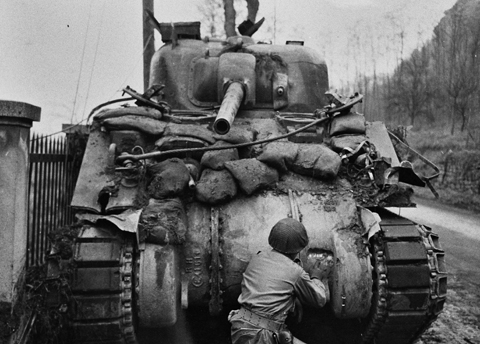
Military Snapshot - Assessing the Damage to an M4 Sherman

An American soldier checks out the gouge that a German armor-piercing projectile made on the front hull of this M4 Sherman medium tank. The cities of Orleans and Dreux fell to Patton’s Third Army on August 16, 1944. Fearing a that continued Third Army advance eastward from Orleans would cut off their forces located in southwest France, the Germans withdrew over 100,000 men eastward from that area. Photo courtesy of General Patton Memorial Museum, from Patton's Third Army in World War II by Michael Green & James D. Brown.

Tuesday, February 15, 2011

From the Pages - War Stories of the Infantry

Overshadowed by the better-known exploits of the 2nd Infantry Division's 4th Marine Brigade, the soldiers of the division's 3rd Infantry Brigade served just as valiantly alongside the Marines in blunting and then counterattacking against the seemingly overwhelming Kaiserschlacht, or Spring Offensive, during World War I.

In the following excerpt from War Stories of the Infantry, Cpl. Frank L. Faulkner, U.S. Army, recounts his brigade's involvement during this months-long series of engagements along the Western Front.

- - - - - - - - - - - - - - - - - - - - - - - - - - - - - - - - - - - - - - - -

On the 12th of March, 1918, traveling in our usual manner we embarked for the front. We traveled to Dugny, a place about five kilometers from Verdun. From here we hiked about eight kilometers to a place called Genicourt, just back of the trenches. It was here that I saw my first view of shell-torn towns and also my first air battles. At that time, it was quite a novel sight, but it soon grew familiar, as they were a daily occurrence.

On March 17th we went in the trenches; of course, we had to travel in the dark. We had full packs, and much of the travel was over the hills and through the woods, so when we reached there, we were pretty well tired out.

We relieved the French, so we did not know much about what sort of a place we were in, but we were told the direction to look for the Germans. It was in a wood; most of the trees had been broken off by shell fire, and only the stumps were left. They looked much like the forms of men, so we spent the rest of the first night shooting up the stumps. That night sort of put us on our feet, and shell fire lost some of its terrors to us. In fact, we soon became able to enjoy a siesta in spite of heavy artillery fire. To say that it does not give you a queer feeling any time when the shells are landing close about you is stretching it a trifle. I went through some mighty heavy barrages afterwards, but I never felt so apprehensive as on that second night.

Friday, February 11, 2011

Armor X-Ray - The M4A4 Tank


This cutaway line drawing of an M4A4 tank shows the many internal and external components that make up the vehicle. The vertically stored 75mm main-gun rounds along the turret ring disappeared from later production units, as they proved very vulnerable in combat when a projectile penetrated the tank. Drawing courtesy of James D. Brown, from M4Sherman at War by Michael Green & James D. Brown.

Wednesday, February 9, 2011

Aviation Snapshot - Mid-air Refueling of the SR


The SR-71 refuels with a KC-135Q tanker. With the boom so far behind the pilot's cockpit, he had to rely exclusively on the tanker's director lights to tell him how well he was doing in maintaining the correct formation position. It took fifteen to twenty minutes to get a full load of JP-7. Photo courtesy of Lockheed Martin, from Flying the SR-71 Blackbird: In the Cockpit on a Secret Operational Mission by Col. Richard H. Graham, USAF (ret.).