Showing posts with label U.S. Army. Show all posts
Thursday, November 10, 2011
Military Snapshot - Crossing the Ourthe River One Half-track at a Time
During the Battle of the Bulge, Houffalize, Belgium proved to be a strategic location. Specifically, Generals Montgomery and Patton met up there, Montgomery coming from the north and Patton from the south, in their counter-attack against the German forces remaining in the area. In this photo, a U.S. Army half-track crosses a temporary bridge over the Ourthe in the war-torn Belgian city of Houffalize, January 1945. Photo courtesy of Associated Press, from Voices of the Bulge: Untold Stories from Veterans of the Battle of the Bulge by Martin King and Michael Collins.
Labels:
Battle of the Bulge,
U.S. Army,
World War II
Wednesday, November 2, 2011
Military Snapshot - Two Brave Souls, a Bed Sheet and a .30-cal
During the Battle of the Bulge, details such as personal camouflage and foxhole cover could mean the different between life and death. In this photo, two GIs use bed sheets as camouflage for themselves and their water-cooled .30-caliber machine gun. While Hitler belittled the fighting abilities of the American soldier, the German soldier soon found how tough they could be during the Battle of the Bulge. Photo courtesy of the National Archives, from War Stories of the Battle of the Bulge by Michael Green & James D. Brown.
Labels:
Battle of the Bulge,
U.S. Army,
World War II
Monday, October 31, 2011
From the Pages - The Battle of Pineapple Forest
The Pineapple Forest
November–December 1967
Having moved into the Pineapple Forest on Halloween, Captain Brown and C Troop, as well as the engineers tasked with flattening the area, operated from a base camp on the north edge of the woods. Rolls of concertina wire were staked around the circular patch of raw earth and more than a dozen tents erected inside: troop tents, mess tents, supply tents, a commo tent, and a tent for the command group, too. The engineers pushed up berms behind which the M48s and ACAVs faced outward at night while guarding the perimeter.
The Chinook that resupplied the base camp each morning delivered not only fuel and ammunition but enough foodstuffs to run a diner: doughnuts, eggs, and cartons of milk and orange juice for breakfast; sandwiches, apple pie, and Kool-Aid for lunch; and for dinner, beer, soda, and steaks cooked to order on field stoves. In addition, the troops plucked pineapples and wild bananas during patrols and went fishing with hand grenades. It was not a bad war in the Pineapple Forest, all things considered. Charlie Troop’s platoons alternately protected the bulldozers as they felled trees—very boring—and, weather permitting, for the monsoon rains sometimes produced mud so thick and deep that armor could not pass, ran missions in those sections of the forest not yet scraped clean. The local-force VC did little more than snipe at the intruders destroying their sanctuary, armed as they were with old carbines and Thompson submachine guns, and obsolete bolt-action Mosin Nagant rifles from Russia.
Labels:
1/1 Cavalry,
U.S. Army,
Vietnam War
Tuesday, October 25, 2011
World War II Tactics 101
![]() |
| Ubisoft/Gearbox Software |
Entering Buildings
One of our frontline leaders felt that it was better to enter the lower floors of buildings so that, if necessary, the building could be burned from the bottom; he was doubtless bearing in mind that the enemy could do the same if our troops were above. This platoon leader found also that after the ground floor was captured, a few AP shots (from an Ml or BAR) upward through the floors would usually bring remaining enemy down with hands in the air. “When the enemy held out in a basement, a well-tamped charge of TNT on the floor above usually proved effective.”
Labels:
Operation Market Garden,
U.S. Army,
World War II
Tuesday, October 11, 2011
From the Pages - War Stories of the Tankers
In the following excerpt from War Stories of the Tankers, Lt. Chris Byron (U.S. Army) recounts his experience as a tank commander in the 70th Tank Battalion at Songhyon-ni, South Korea on October 12, 1950.
_ _ _ _ _ _ _ _ _ _ _ _ _ _ _ _ _ _ _ _ _ _ _ _ _ _ _ _ _ _
I served in the Korean War as a platoon leader and was a member of the 70th Tank Battalion, which was attached to the 1st Cavalry Division.
In Korea, because of the terrain, tank battalions and even tank companies didn’t operate together as a unit. We were usually parceled out to an infantry unit. Quite often, it was just a platoon of tanks that was attached to an infantry battalion, and the platoon operated under the direction of the infantry battalion commander. Chances were that he didn’t know anything about tanks. Even so, some of them were pretty good. One would say to me, “Tell me how you can help us in this mission that we have.” Others were bullheaded and told you what to do. They thought they knew everything, like the one that I worked under quite a bit, Lt. Col. Paul Clifford. A good example would be on October 12, 1950.
Colonel Clifford commanded the 2nd Battalion of the 5th Cavalry Regiment. His battalion was given the mission of passing through the 8th Cavalry in a place called Songhyon-ni and attacking toward Kumchon, South Korea. On that morning, Colonel Clifford told me that he wanted me to lead an attack through a valley that contained heavy ground fog. Fog was not a common occurrence in Korea, but on that day, it was thick. I told the colonel that because of the heavy ground fog the gunners could not see through their telescopic sites; under those circumstances, it would be much better if the infantry lead the attack. His reply to me was, “If you can’t see them, they can’t see you.” Of course, you know, they could hear us coming, and because of the size of the tanks, we would be seen first. Tanks in those days were not known for their stealth in storming enemy positions.
Labels:
Armor,
Korean War,
U.S. Army
Friday, September 30, 2011
Vehicle Breakdown - Fast Attack Vehicle (FAV)
Fast Attack Vehicles (FAVs) were first introduced into military service in 1980 with the 9th Light Infantry Division of the U.S. Army. The program lasted until the mid 1980s, around which time the U.S. Special Operations Forces took deliver of a number of the FAVs, and as one of the troops comments, "We began to tinker with them." Today, this modified dune buggy, which now is fitted for three men, is officially called the Desert Patrol Vehicle (DPV), although it also carries the moniker of Light Strike Vehicle and is still referred to as the FAV. Excerpted with permission from Weapons of Delta Force by Fred J. Pushies.
Labels:
Delta,
Special Operations,
U.S. Army
Monday, September 26, 2011
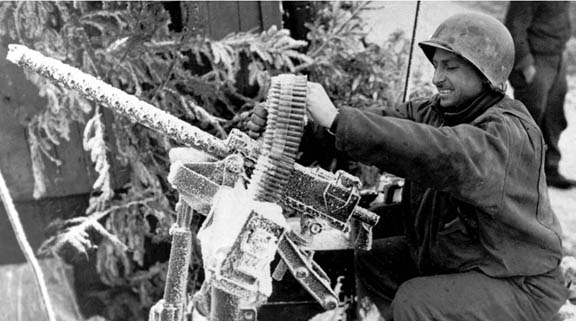
Military Snapshot - Prepping a Frozen 'Ma Duece' in the Ardennes
The original .50-caliber machine gun was developed by John Browning in 1918. An improved version was adopted in 1933 as the Browning M2 water-cooled machine gun. The legendary M2, with nicknames like the "Faithful 50" and "Ma Duece," is an automatic, belt-fed, recoil-operated, air-cooled, crew-operated machine gun. This versatile and reliable gun had many uses and proved to be a valuable defensive weapon during the Battle of the Bulge. In this photo, a soldier preps ammo for his visibly frozen .50 cal. Photo courtesy of U.S. Army, from Voices of the Bulge: Untold Stories from Veterans of the Battle of the Bulge by Michael Collins and Martin King.
Labels:
Battle of the Bulge,
U.S. Army,
World War II
Monday, September 19, 2011
Profile of a Legend - General Creighton W. Abrams
| Photo courtesy of U.S. Army |
by Brian M. Sobel, excerpted from M1 Abrams at War
The speed, power, mobility, and fire capability of the M1 Abrams tank is the very personification of the general whose name is indelibly associated with one of the world’s most feared battlefield weapons. Named for Creighton W. Abrams, who rode the lead tank in numerous engagements during World War II, the M1 gives a commander a variety of options, something Abrams knew was vitally important in battle.
The story of Creighton Abrams and his advancement through the ranks of the United States Army, up to and including army chief of staff, is the material of legend, as were his exploits during three wars. In World War II, he achieved victory after victory against the Germans, including a heroic breakthrough to relieve Bastogne during the famed Battle of the Bulge. The general they called Abe was tough, demanding, gruff, and loved his soldiers. In turn, his soldiers loved him.
The fighting general was born in Springfield, Massachusetts, in 1914 to Creighton and Nellie Abrams. The oldest of three children, Abrams was a success early in life. As a senior in high school he was the captain of the 1931 Agawam High football team that went undefeated and unscored-upon. As important in his overall development, Abrams was also the class president, class orator, and editor of the school paper, and in a singular honor voted by his classmates as the boy most likely to succeed.
Tuesday, September 13, 2011
Beyond the Book - Q & A with Martin King and Michael Collins, authors of "Voices of the Bulge"
In their new book and film, Voices of the Bulge, authors Martin King and Michael Collins provide new perspectives about and amplify new voices from one of the most intriguing and iconic battles of World War II -- the Battle of the Bulge. In Voices, the authors interview both German and American veterans, as well as civilians from the Ardennes region, to provide a uniquely balanced look at the engagement that shifted the tide of the war.
King and Collins recently took a moment to sit down with Zenith Press to discuss Voices of the Bulge and the awe-inspiring stories that fill its pages.
_ _ _ _ _ _ _ _ _ _ _ _ _ _ _ _ _ _ _ _ _ _ _ _ _ _ _ _ _ _ _ _ _ _ _ _ _ _ _ _
ZENITH PRESS: When did each of you first become intrigued by the Battle of the Bulge?
KING: I’ve always been interested in military history. My Grandfather had fought at Passchendale in the First World War, and I still have his medals. But it was while I was teaching European History at the university that I first heard about the Battle of the Bulge. I received a letter from Mr. James L. Cooley a 106th Division veteran (who appears in Voices of the Bulge). At his request I did some research on his unit and became absolutely engrossed in the story. Some months later I accompanied Mr. Cooley and his family back to the places he had fought in the Ardennes. That started me off 20 years ago. After that I wrote a paper on the Siege of Bastogne and began reading the works of McDonald, Toland and Whiting etc. They had all written excellent accounts of the battle, but they were also very subjective. Michael and I wanted to mildly emulate Stephen Ambrose's Band of Brothers approach. Get it from the horse’s mouth, for want of a better analogy. Unlike the previous authors, I live in quite close proximity to the actual area of the Ardennes where the battle occurred. As a result, I was able to jump in my car and visit whenever I liked. This gave me the possibility of really analyzing the battle from all angles.
COLLINS: The Battle of the Bulge is very personal for me. As I mention at the end of Voices of the Bulge, my grandfather fought in battle with the 10th Armored Division and survived despite the confusion, bitter cold, and difficult terrain. He never spoke of his experiences, and I never knew him, since he died before I was born. In 2005, my parents and I decided that we wanted to visit the D-day beaches in Normandy and also tour the Bastogne-area of Belgium. As it so happened, Martin showed us around. We started out early and, after seeing a few sites within Bastogne, Martin took us all over the Ardennes region, even into Luxembourg. It was the trip of lifetime to see the different places that I later heard veterans talk about, and it made my research even more fulfilling. I visit Martin in Belgium at least once a year, and it has become almost a second home to me. I had also read about the Battle of the Bulge through books by Toland and McDonald, but they were written over 50 years ago. I think we’ve learned so much more about it since then. Co-writing one has been a great journey. Hearing the stories from the veterans who fought in the battle gave me an even greater appreciation of the sacrifice they made during World War II.
Labels:
Battle of the Bulge,
U.S. Army,
World War II
Tuesday, September 6, 2011
Military Snapshot - M1A1 Abrams: 1, Insurgent Hideout: 0
The destructive firepower of the M1A1 Abrams 120mm main gun completely demolished an insurgent’s hideout. Infantrymen in the vicinity had to ensure they were some distance away from the gun, or the blast shock wave could cause bleeding from the nose and ears and take one’s breath away. Photo courtesy of Defenseimagery.mil, from Operation Phantom Fury: The Assault and Capture of Fallujah, Iraq by Dick Camp.
Monday, August 22, 2011
Military Snapshot - GIs Taking Cover in Rennes
Under fire, American soldiers hug the ground. Before the 4th Armored Division could take the major Breton port of Lorient it had to take some intermediate objectives such as the city of Rennes, the capital of Brittany. This occured on August 4 with the help of an infantry regiment. Photo courtesy of National Archives, from Patton's Third Army in World War II by Michael Green & James D. Brown.
Labels:
U.S. Army,
World War II
Monday, August 8, 2011
Rescue Ops. - Apaches to the Cavalry's Rescue
![]() |
| Photo courtesy of U.S. Army. |
_ _ _ _ _ _ _ _ _ _ _ _ _ _ _ _ _ _ _ _ _
In the summer of 2007, Chief Warrant Officers Mark Burrows and Steven Cianfrini with the 17th Cavalry Regiment’s Troop C, 3rd Squadron, took off from their base in Iraq. What began as a routine reconnaissance mission with a sister scout helicopter would turn into a life or death situation for the two OH-58 Kiowa pilots.
The aviators were supporting an infantry unit south of Baghdad and had just located a suspected roadside improvised explosive device (IED). Chief Warrant Officer Cianfrini was the first to spot the enemy fire as tracers reached out to the OH-58 from the ground below. Chief Cianfrini immediately called out to Chief Warrant Officer Burrows to evade the incoming rounds. As the small-arms fire ceased, the pilots made the decision to return to base and assess any damage. All of a sudden, a heavy machine gun opened up on the small scout helicopter. Large caliber rounds began to impact the vulnerable Kiowa over and over. There was no time to locate and engage the enemy with the aircraft’s weapons. The pilots bobbed and weaved as best they could to avoid the incoming rounds.
Chief Warrant Officer Cianfrini recalled, “I saw the tracer rounds come up through the rotors, and at that point we tried to get out of range, check our instruments, make sure our systems were good and that nobody was hit.” As they continued to evade the enemy fire, several rounds from the machine gun found their mark. Slamming into the aircraft, the cockpit was abuzz with warning alarms and warning lights. More rounds hit the aircraft and destroyed the instrument panel. Chief Warrant Officer Cianfrini related, “One second it was there; the next it was a mess of wires.”
Tuesday, May 10, 2011
From the Pages - Battle for the City of the Dead
The following excerpt is pulled from Chapter 10 ("Tomb Job") of Battle for the City of the Dead: In the Shadow of the Golden Dome, Najaf, August 2004 by Col. Dick Camp.
- - - - - - - - - - - - - - - -
“It was like New Orleans meets Baghdad.”
—U.S. Army officer describing the Wadi al-Salaam cemetery
Alpha Company jumped off early in the morning of August 8. “We cleared the little carnival area with negative contact,” Alpha Company’s commander, Capt. Kevin Badger, said. “We didn’t find anything.” The company held up until about 2 p.m., when, Badger said, “Colonel Miyamasu called and told me to initiate operations in AO Mad Dog [Alpha Company’s area of operations].”
First Lieutenant Steven D. Stauch added, “We were basically on station as a kind of reserve for about two hours at that point. We waited for Bravo and Charlie to clear down to Phase Line Bronx, and once they got to that point, then we were brought in to start clearing our sector.” Each company was given about a one-thousand-meter frontage.
Labels:
5th Cavalry Regiment,
Iraq,
Najaf,
U.S. Army,
U.S. Marines
Monday, April 25, 2011
From the Pages - History of the 10th Mountain Division in World War II
Excerpted from 10th Mountain Division by Fred Pushies
Chapter 2: 10th Mountain Division—World War II
With the Allied invasion on the beaches of Normandy, France, on June 6, 1944, combat in Italy was relegated to the background. For the soldiers of the 10th Mountain Division fighting in the Apennine Mountains, it was far from the “forgotten front.” For the German Army as well, the battles in the Italian Alps were as real and lethal as those their comrades were facing in France. During the campaign the mountain soldiers of the 10th would do battle with nine German divisions that were well entrenched and occupying the high ground. By the end of the campaign, five of the nine German divisions would be totally destroyed as effective combat units. The men of the 10th Mountain Division not only had to fight the Germans, but also had to deal with the environment and elements—the jagged mountains, cliffs, rivers, lakes, and towns. In early January 1945, the 86th Infantry Regiment arrived at the frontlines near Mount Belvedere in the North Apennine Mountains of Italy.
By January 20, 1945, all three regiments of the 10th had arrived in Italy and were positioned along the Serchio Valley and Mount Belvedere. The 85th was commanded by Col. Raymond Barlow, the 86th by Col. Clarence Tomlinson, and the 87th by Col. David Fowler. Here, the division was up against the German positions that were positioned along the five–mile-long Mount Belvedere–Monte della Torraccia Ridge. General Lucian Truscott Jr., who had just taken command of the Fifth Army, informed General Hays of his strategy for dealing with the enemy. The plan called for the 10th to first capture Mount Belvedere, which served as an enemy observation post. The artillery observation post provided the Germans with a view of Highway 65, which was one of the main routes into the Po Valley. Protecting Mount Belvedere were more Germans on Riva Ridge toward the west.
Labels:
10th Mountain Division,
Normandy,
U.S. Army,
World War II
Subscribe to:
Posts (Atom)