
Tuesday, February 22, 2011
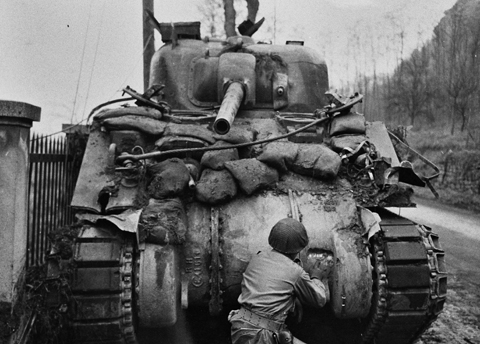
Military Snapshot - Assessing the Damage to an M4 Sherman

Thursday, February 17, 2011
Tuesday, February 15, 2011
From the Pages - War Stories of the Infantry
 Overshadowed by the better-known exploits of the 2nd Infantry Division's 4th Marine Brigade, the soldiers of the division's 3rd Infantry Brigade served just as valiantly alongside the Marines in blunting and then counterattacking against the seemingly overwhelming Kaiserschlacht, or Spring Offensive, during World War I.
In the following excerpt from War Stories of the Infantry, Cpl. Frank L. Faulkner, U.S. Army, recounts his brigade's involvement during this months-long series of engagements along the Western Front.
- - - - - - - - - - - - - - - - - - - - - - - - - - - - - - - - - - - - - - - -
On the 12th of March, 1918, traveling in our usual manner we embarked for the front. We traveled to Dugny, a place about five kilometers from Verdun. From here we hiked about eight kilometers to a place called Genicourt, just back of the trenches. It was here that I saw my first view of shell-torn towns and also my first air battles. At that time, it was quite a novel sight, but it soon grew familiar, as they were a daily occurrence.
On March 17th we went in the trenches; of course, we had to travel in the dark. We had full packs, and much of the travel was over the hills and through the woods, so when we reached there, we were pretty well tired out.
We relieved the French, so we did not know much about what sort of a place we were in, but we were told the direction to look for the Germans. It was in a wood; most of the trees had been broken off by shell fire, and only the stumps were left. They looked much like the forms of men, so we spent the rest of the first night shooting up the stumps. That night sort of put us on our feet, and shell fire lost some of its terrors to us. In fact, we soon became able to enjoy a siesta in spite of heavy artillery fire. To say that it does not give you a queer feeling any time when the shells are landing close about you is stretching it a trifle. I went through some mighty heavy barrages afterwards, but I never felt so apprehensive as on that second night.
Friday, February 11, 2011
Armor X-Ray - The M4A4 Tank

This cutaway line drawing of an M4A4 tank shows the many internal and external components that make up the vehicle. The vertically stored 75mm main-gun rounds along the turret ring disappeared from later production units, as they proved very vulnerable in combat when a projectile penetrated the tank. Drawing courtesy of James D. Brown, from M4Sherman at War by Michael Green & James D. Brown.
Wednesday, February 9, 2011
Aviation Snapshot - Mid-air Refueling of the SR

The SR-71 refuels with a KC-135Q tanker. With the boom so far behind the pilot's cockpit, he had to rely exclusively on the tanker's director lights to tell him how well he was doing in maintaining the correct formation position. It took fifteen to twenty minutes to get a full load of JP-7. Photo courtesy of Lockheed Martin, from Flying the SR-71 Blackbird: In the Cockpit on a Secret Operational Mission by Col. Richard H. Graham, USAF (ret.).
Monday, February 7, 2011
Thursday, February 3, 2011
Zenith Op-Ed - A Third Alternative for the War in Afghanistan
A Third Alternative for the War in Afghanistan
By Stephen L. Melton, author of The Clausewitz Delusion: How the American Army Screwed Up the Wars in Iraq and Afghanistan (A Way Forward)

Nearly all reporting and polling data coming from Afghanistan indicates that both the Taliban and the Karzai government in Kabul are overwhelmingly unpopular among the population. The Taliban will never be forgiven for their atrocities and incompetence during the years they ruled. The Karzai government in Kabul is accurately seen as largely corrupt, incapable, and arrogant. We Americans, whom many Afghans dismiss as occupiers, are viewed by the majority as powerful and generally well-meaning--but we are, after all, outsiders without a true understanding of or lasting interest in the realities and subtleties of Afghan life. The population is tragically trapped between three competing entities—the Kabul government, the Taliban, and the Americans—none of which offers them clear hope for the future. So it’s small wonder that great swaths of Afghan society are disaffected and confused.
Tuesday, February 1, 2011
Subscribe to:
Posts (Atom)